Here's a number that should make every insurance agent uncomfortable: the average agent makes 1.3 follow-up attempts on a lead before marking it dead.[1] The research on when insurance leads actually convert tells a completely different story — more than half of all conversions happen after the fifth contact attempt, and the curve doesn't flatten until attempt eight.
Most agents are stopping at attempt one, marking the lead cold, and buying more data to fill the gap. They're not running out of leads. They're running out of patience with leads that would have converted if they'd been worked properly. Here's the 14-day sequence that fixes that.
The Principles Behind a Sequence That Works
Before the specific schedule, three principles that determine whether any multi-touch sequence actually produces results:
Principle 1: Channel Variation
Calling the same number every day is the fastest way to get added to a block list. An effective sequence rotates channels — phone call, voicemail drop, SMS (on mobile-consented numbers), and for some operations, email. Each channel reaches the prospect differently and creates multiple opportunities for a low-friction first response (a reply text is much easier than calling back).
Principle 2: Timing Variation
If a prospect didn't answer at 10 AM on Monday, dialing them at 10 AM on Tuesday demonstrates nothing except that you didn't learn from Monday. Vary your attempt times across the day and across the week. The prospect who doesn't answer Tuesday morning calls may pick up Thursday at 5 PM because their schedule is different. You don't know their pattern until you've tested multiple windows.
Principle 3: Message Escalation — Not Repetition
Each touch in the sequence should feel different from the last one — not a carbon copy of the same call with a new date stamp. The sequence below builds progressively: early touches are exploratory, middle touches are direct, late touches use a final close technique that signals this is the last contact before you stop trying.
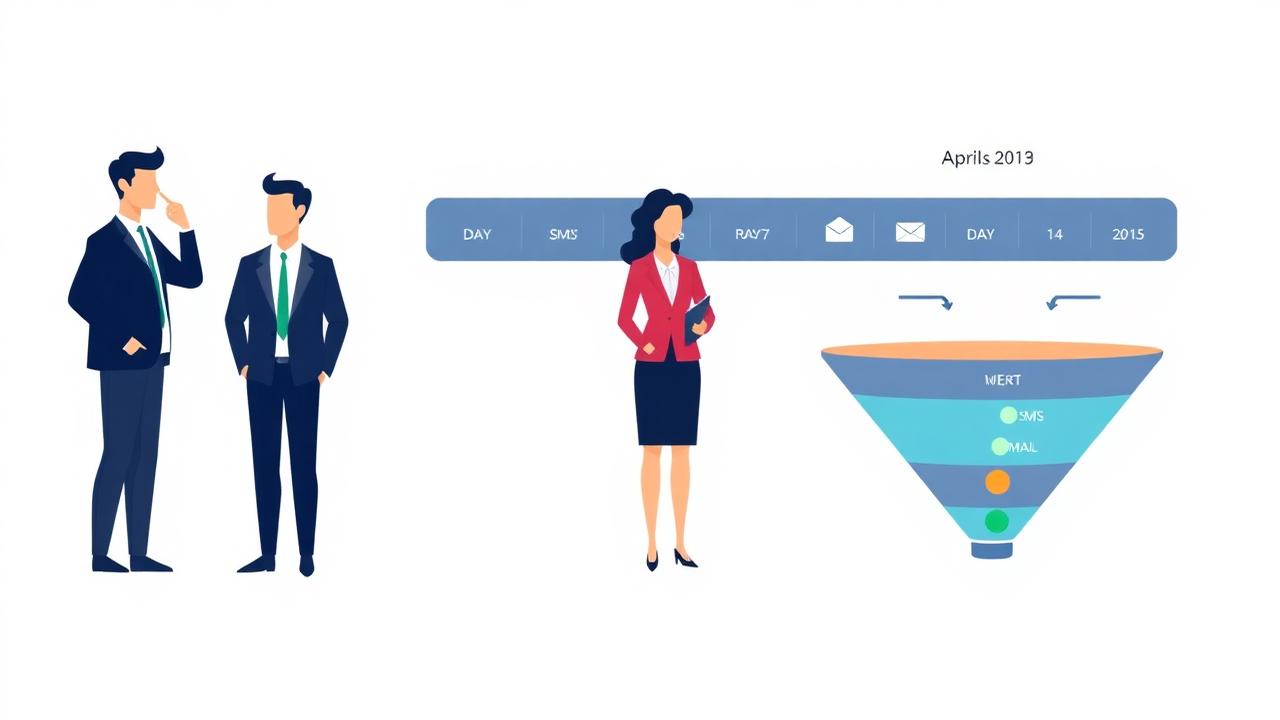
The 14-Day, 8-Touch Follow-Up Sequence
DAY 1 — Touch 1: First Call (Morning)
Live call attempt. If no answer: hang up, no voicemail. You're establishing caller ID recognition before introducing yourself by voice.
DAY 1 — Touch 2: SMS (same day, 2+ hours after call)
"Hi [Name], this is [Agent] with [Agency]. I tried reaching you earlier about Medicare options in [State]. Reply STOP to opt out or call me at [#] when you have 2 minutes." Mobile-consented numbers only.
DAY 2 — Touch 3: Voicemail Drop (Late Afternoon)
First voicemail. Introduce yourself, state your purpose in one sentence, give your number twice. Under 20 seconds. (See Blog Post #32 for full voicemail script.)
DAY 4 — Touch 4: Live Call Attempt (Different Time Window)
If reached: full pitch. If no answer: hang up, no message. The voicemail on Day 2 is working — adding another one too quickly feels like harassment.
DAY 6 — Touch 5: Live Call + Voicemail (Morning)
Second voicemail — different angle. Lead with a value statement: "I wanted to follow up because I found a plan in your area that covers [benefit] with no premium increase — call me back at [#]." Under 20 seconds.
DAY 9 — Touch 6: SMS Follow-Up #2
Different message angle: "Still have that [Medicare/final expense/health] question for you when you're ready — no pressure. [Agent Name], [Agency], [#]. Reply STOP to opt out."
DAY 11 — Touch 7: Live Call Attempt (Peak Window — Wed/Thu Afternoon)
Best timing attempt of the whole sequence. If no answer: no message.
DAY 14 — Touch 8: Final Close Voicemail
The "breakup" message: "Hi [Name], this is [Agent] — I've tried reaching you a few times about [product]. I don't want to keep bothering you, so this will be my last call. If you ever have questions about [product] in [State], I'm here at [#]. Take care." This message converts at a higher rate than any other in the sequence — the signal that you're stopping creates urgency.
Why the "Breakup" Message Works
The Day 14 final touch is built on a well-documented psychological principle: reactance — the human tendency to want something more when they sense they're about to lose access to it.[2] A prospect who has been passively aware of your calls for two weeks but hasn't engaged suddenly faces a decision: if I don't respond now, this option goes away. A meaningful percentage call back within 24–48 hours of receiving that final message.
This only works if it's genuine — if you actually do stop contacting after Day 14 (absent a new consent signal). Saying "this is my last call" and then calling again three days later destroys the trust and the technique.
How to Manage This Without Losing Your Mind
A sequence like this is impossible to run manually across hundreds of leads. You need either a CRM with automated sequence capabilities or a standalone outreach tool that can schedule touches, log attempts, and flag contacts for live calls at the right time.
At minimum, track: lead name, phone, date first contacted, last attempt date, attempt count, and channel log (what you tried and when). Even a spreadsheet with those six columns is better than the single-dial-and-forget approach most operations run. Browse cleanleads365.com/cleaner for leads that include the data fields (lead age, line type, verification date) you need to run this sequence correctly from day one.
Frequently Asked Questions
References
- Velocify / Velocify by Ellie Mae. (2012). Optimal Lead Response: What 3.5 Million Calls Taught Us About Sales Follow-Up.
- Brehm, J.W. (1966). A Theory of Psychological Reactance. Academic Press.
- Federal Trade Commission. TSR 16 C.F.R. § 310.4(b)(1)(iii)(A). DNC request honor requirement.