
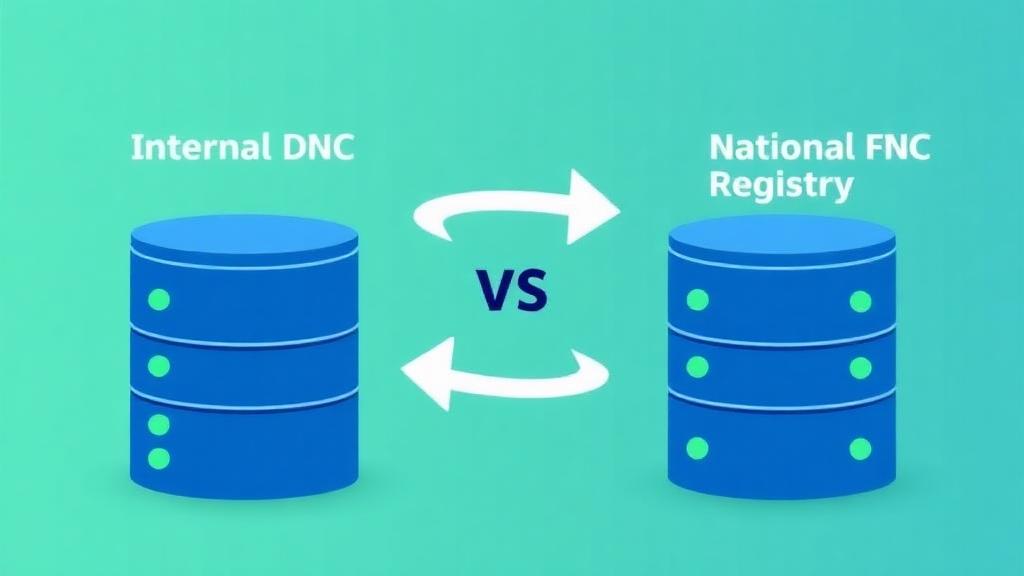
Yes — and for different legal reasons. The national registry is a federal database. Your internal DNC list is a separate requirement covering people who've asked you specifically not to call. Missing either one is a violation.
What the National DNC Registry Is
The National Do Not Call Registry is a federal database administered by the FTC under the Telemarketing Sales Rule (16 C.F.R. Part 310) and the National Do Not Call Registry Act of 2003. It contains over 249 million phone numbers.
The registry is a universal, consumer-directed protection. Consumers register once, and all telemarketers must honor that registration — forever, or until the consumer cancels.
What an Internal DNC List Is
Your internal DNC list is the record of every person who has contacted your company specifically and asked not to be called. The requirement is established in 16 C.F.R. § 310.4(b)(1)(iii)(A), which prohibits calling a person who has previously stated they do not wish to receive calls from you.
This requirement is entirely independent of national registry status. A person's number might not be on the national registry at all — but if they called your agency and said 'please don't call me again,' you are prohibited from calling them.
The Four Critical Differences
1. Who Controls Registration
National registry: Consumer registers with the federal government. Applies against all telemarketers.
Internal list: Consumer requests directly with your company. Applies only to your organization.
2. Scope of Protection
National registry: Protects the number from all covered telemarketers.
Internal list: Protects the consumer from being called by your company — even if the number is not on the national registry.
3. Time to Honor
National registry: Protection takes effect 31 days after registration.
Internal list: Must be honored within 30 days, maintained for minimum 5 years.
4. Retention Requirement
National registry: You must re-download every 31 days. You don't store consumer numbers.
Internal list: You maintain the list yourself. The FTC can audit it. Minimum 5 years retention.
"A DNC request to any agent applies to all agents in the organization. There is no 'I didn't know about the request' defense."
How Internal DNC Requests Are Created
Any verbal or written communication from a consumer requesting not to be called creates an internal DNC obligation:
- A consumer who says 'take me off your list' during a live call
- A consumer who sends an email or texts 'STOP'
- A consumer who clicks an unsubscribe link
- A written letter requesting no further contact
- A consumer's attorney sending a demand to cease contact
The obligation is company-wide. It applies to all agents, all phone campaigns, and all third parties calling on your behalf.
What Happens When You Miss a Request
Calling someone after they've made a company-specific DNC request is a separate violation from calling a national registry number. Both can be enforced simultaneously. Courts have found that ignoring a specific request demonstrates a particularly high degree of consumer harm.
Building a Functional Internal DNC System
- Centralized database: Company-wide system, not individual spreadsheets
- Real-time logging: Log requests immediately during the call, not as a post-call task
- Pre-campaign scrub: Run lists against both the national registry AND your internal list before every campaign
- Same-day honor: 30 days is the legal max; honor requests the same day
- 5-year retention: Phone number, date, channel, and agent name for each request
The Third Layer: State-Specific Internal DNC Requirements
Several states impose stricter requirements. California (under CCPA), Florida, Texas, and Indiana all have state-level telemarketing statutes with specific internal DNC provisions. For multi-state operations, apply the strictest applicable rule uniformly.